Bernardo Bertolucci’s The Dreamers is a film that should be introduced with care. It is visually beautiful, intellectually playful, and deeply connected to film history, but it is also an adult art-house drama built around emotional dependency, erotic tension, and youthful self-enclosure. Released in 2003, the film was directed by Bertolucci from a screenplay by Gilbert Adair, based on Adair’s novel The Holy Innocents. It stars Michael Pitt as Matthew, Eva Green as Isabelle, and Louis Garrel as Théo, and is set in Paris during the political atmosphere of 1968.
At first glance, The Dreamers looks like a story about three young people discovering each other inside a Paris apartment. But that summary is too small. The film is also about cinephilia, political romanticism, the mythology of youth, and the danger of mistaking private fantasy for historical action. Bertolucci presents Paris not simply as a city, but as an archive of images: movie houses, old posters, revolutionary slogans, corridors, bedrooms, cafés, and streets where personal awakening and public upheaval seem to overlap.

The story begins with Matthew, an American student in Paris, who spends much of his time at the Cinémathèque Française. This is not a random setting. The Cinémathèque was one of the sacred spaces of postwar film culture, especially for the generation shaped by the French New Wave. The New Yorker’s historical account of the Langlois Affair explains that Henri Langlois, the legendary head of the Cinémathèque, was removed from his position in February 1968, provoking a major protest movement among filmmakers and film lovers. That incident became a symbolic prelude to the larger unrest of May 1968.
Matthew meets Isabelle and Théo during this moment of cinematic protest. The meeting is important because the film immediately links friendship, desire, politics, and cinema. These three young people do not first connect through ordinary conversation. They connect through images, references, gestures, and a shared belief that movies are not just entertainment but a way of living. They quote films, reenact scenes, argue over directors, and turn their knowledge of cinema into a private language.
In this sense, The Dreamers is one of the most explicit films ever made about cinephilia as a lifestyle. Roger Ebert described the film as extraordinarily beautiful and emphasized Bertolucci’s ability to bathe his characters in the glow of classic movies and cinematic references. This is a useful way to understand the film’s surface pleasure. Bertolucci does not merely mention cinema history; he folds it into the behavior of the characters. They imitate famous scenes not as academic exercises, but as if movies have replaced ordinary social training.
The most famous example is the trio’s race through the Louvre, echoing Jean-Luc Godard’s Bande à part. The scene is playful, charming, and self-aware. It captures the film’s central paradox: these characters want to be alive, but they often experience life through prior images. They are not simply running through a museum; they are running through a memory of cinema. Their rebellion is already a quotation.
That is one of the film’s most intelligent ideas. The Dreamers understands that youth culture often begins by imitation. Young people discover themselves through borrowed styles, political slogans, favorite songs, movie scenes, and admired gestures. The question is whether imitation can become genuine experience, or whether it traps the characters inside a beautiful but limited performance.
Adult movieThe apartment is the film’s real center. Once Isabelle and Théo’s parents leave Paris, Matthew is invited to stay, and the three young people gradually retreat from the outside world. The New Yorker described the apartment as one of the film’s most interesting “characters”: a worn but beautiful bohemian grand bourgeois space filled with books, pictures, corridors, and secret corners. This is exactly right. The apartment is not simply a setting. It is a private republic, a dream chamber, and eventually a sealed emotional system.
Inside the apartment, the characters create rules. They invent games. They test each other’s knowledge of film history. They turn intellectual failure into intimate penalty. But the games are not only playful. They reveal a structure of control. Isabelle and Théo already exist as an intense pair before Matthew enters. Matthew becomes both guest and intruder, student and witness, participant and outsider. The film’s tension comes from the fact that he is attracted to their world, but never fully belongs to it.
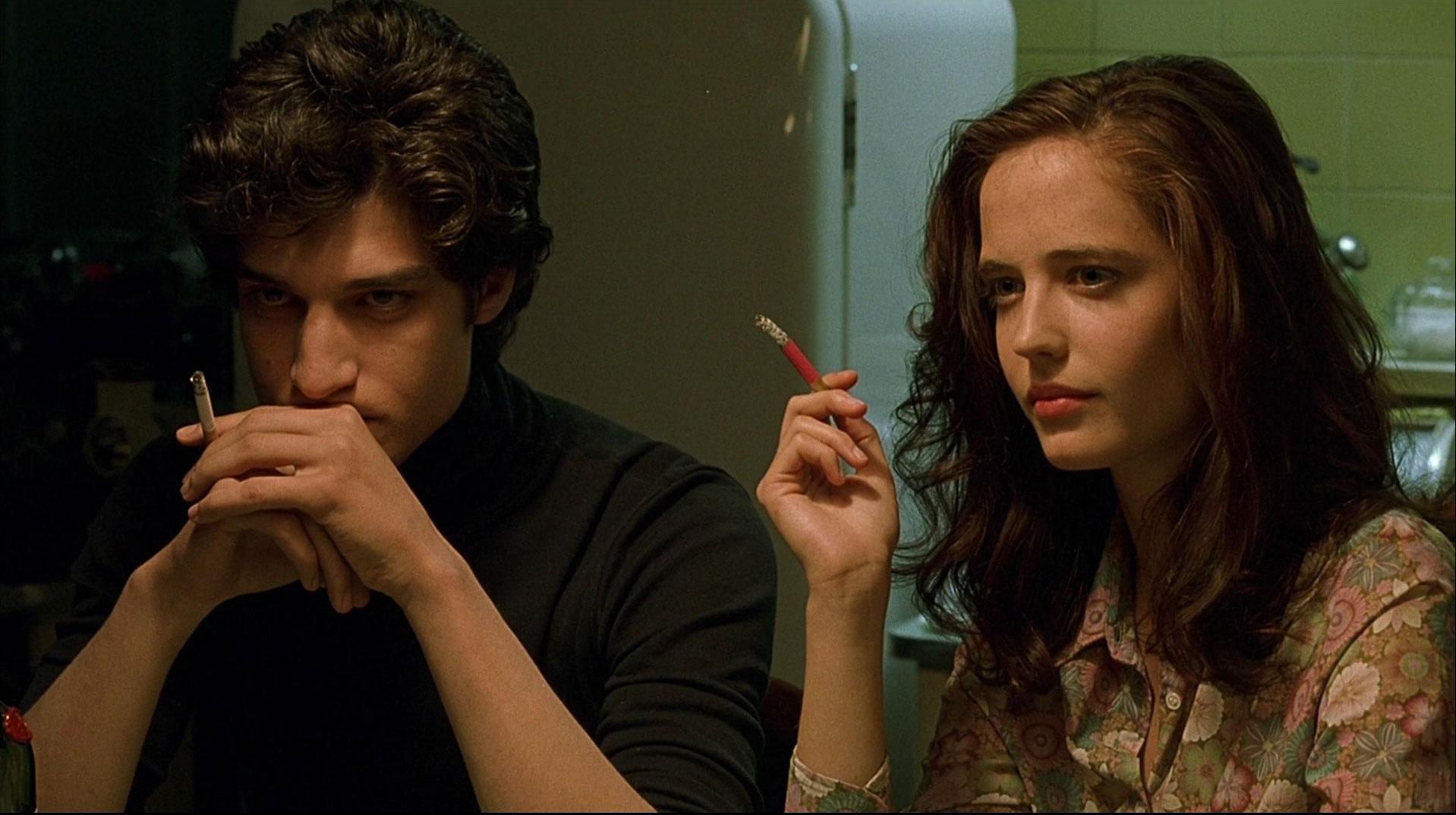
Isabelle and Théo are twins, and Bertolucci films their bond as both fascinating and troubling. Their closeness is theatrical, possessive, and partly childlike. They share references, habits, moods, and private codes. They often seem like two halves of a single closed identity. Matthew’s arrival disturbs that identity, but it does not destroy it. In many ways, he becomes a temporary audience for a performance that was already happening before he arrived.
This is why Matthew is such an effective point-of-view figure. He is American, foreign, observant, and somewhat naïve. He arrives in Paris with a romantic belief in European culture, political intensity, and cinematic sophistication. Isabelle and Théo appear to him like living embodiments of everything he came to find: intelligence, beauty, danger, and freedom. But the longer he stays with them, the more the fantasy darkens.
The film can be read as a coming-of-age story, but not in the simple sense of maturity gained through experience. Matthew’s education is ambiguous. He learns about desire, but also about dependency. He learns about political passion, but also about fashionable radicalism. He learns about cinema, but also about the danger of confusing cinema with life. The film’s title, The Dreamers, is therefore both affectionate and critical. These characters dream intensely, but dreams can protect people from reality as much as they can inspire change.
Bertolucci’s attitude toward the trio is complicated. He loves their beauty, intelligence, and enthusiasm. He clearly remembers the glamour of being young, serious, and convinced that art can transform the world. At the same time, he does not fully trust them. The film is nostalgic, but not innocent. It shows how easily political language can become decoration when separated from actual collective struggle. Théo talks about revolution, but inside the apartment he lives in comfort. Isabelle performs freedom, but she is deeply bound to the enclosed world she shares with her brother. Matthew wants experience, but often mistakes proximity for understanding.
This is where the historical background becomes essential. May 1968 in France was not merely a backdrop of posters and street noise. It involved student protests, worker strikes, police confrontation, and a national crisis of authority. The New Yorker notes that by late May, nearly ten million students and workers were on strike, and the country was virtually shut down. Against that scale of public upheaval, the trio’s private drama can seem small, even self-indulgent. Bertolucci seems aware of this contrast.
The film’s central movement is from the street to the apartment, and then back to the street. At the beginning, the characters meet during a public protest connected to cinema. In the middle, they withdraw into private games, private desire, and private mythology. At the end, the outside world breaks back in. This structure is simple but powerful. It suggests that history does not disappear just because young people close the curtains.
The brick that enters the apartment near the end is one of the film’s strongest symbols. It is not subtle, but it is effective. The sealed dream-world is literally shattered by political reality. The characters must decide whether to remain in fantasy or step into history. Yet the film does not present this decision as simple heroism. The movement into the street is also chaotic, impulsive, and morally uncertain. Bertolucci understands that revolution can be both necessary and theatrical, both liberating and dangerous.

One of the most interesting ways to discuss The Dreamers is to see it as a film about three utopias: cinematic, political, and intimate. The BFI’s Sight & Sound review notes that Bertolucci himself described the film as being about three utopias centered on his memories of May 1968: political, cinematic, and sexual. This framework is extremely helpful because the film’s structure is built around the overlap and failure of these ideals.
The cinematic utopia is the belief that movies can teach people how to live more intensely. Matthew, Isabelle, and Théo treat films as sacred texts. They do not merely watch them; they inhabit them. The problem is that cinema becomes a substitute for reality. They are so trained by images that even their spontaneity feels rehearsed.
The political utopia is the belief that society can be transformed by youth, imagination, and rebellion. The film respects that belief, but also questions it. Théo’s radicalism is sincere in feeling but often performative in practice. Matthew’s pacifism is sincere but perhaps politically limited. Isabelle’s attachment to the twins’ private world makes her relationship to public politics unstable. None of the three possesses a complete answer.
The intimate utopia is the belief that private relationships can escape ordinary social rules and create a freer form of living. This is the most dangerous utopia in the film. Inside the apartment, the trio seems to build a world beyond family, marriage, nationality, and conventional identity. But freedom without boundaries becomes unstable. The more private the world becomes, the more fragile and suffocating it feels.
This is why the film should not be discussed only as a provocative adult drama. Its mature content is part of its subject, but not the whole subject. Bertolucci is interested in the relationship between freedom and enclosure. The characters believe they are escaping society, but they may simply be building another kind of room. Their games seem liberating at first, then increasingly ritualized. Their closeness seems open, then possessive. Their private language seems rich, then claustrophobic.
Eva Green’s Isabelle is the film’s most striking figure. This was Green’s first credited film appearance and is widely considered her breakthrough role. Isabelle is not simply a symbol of seduction or rebellion. She is theatrical, vulnerable, commanding, and deeply dependent on the structure she shares with Théo. Her beauty is central to the film’s visual world, but Bertolucci also makes her a figure of instability. She performs confidence, yet her identity is fragile when the private world is threatened.
Louis Garrel’s Théo is equally important. He is elegant, ideological, sharp, and often arrogant. He represents a type of young intellectual who has absorbed revolutionary language, cinematic history, and masculine performance into one style. Yet the film does not fully mock him. Théo is not empty. He is intelligent and passionate, but he is also protected by class comfort and by the closed bond with Isabelle. His politics become most questionable when they remain inside the apartment as speech rather than action.
Michael Pitt’s Matthew brings a different energy. He is softer, more uncertain, and more morally hesitant. He loves cinema, but he is less theatrically French than the twins. He becomes fascinated by their freedom, but he also senses danger in their self-enclosure. Near the end, his discomfort becomes clearer. He is not merely rejected by the twins; he chooses a different ethical position, especially when political action risks turning into violence.
The performances work because all three actors convey youth as both radiant and foolish. Bertolucci does not present youth as pure wisdom. He presents it as a state of intensity, self-invention, vanity, sensitivity, and danger. The characters are not mature political actors or stable adults. They are beautiful, intelligent, confused young people trying to turn culture into identity.
The film’s beauty is undeniable. The colors are warm, textured, and nostalgic. The apartment has the look of a lived-in museum: peeling walls, old furniture, books, posters, records, and heavy curtains. Paris appears as a city of memory rather than documentary realism. Bertolucci’s camera turns rooms into emotional climates. Ebert’s description of Bertolucci as one of the great painters of the screen fits the film especially well.
Yet that beauty can also be criticized. Some viewers see the film as too indulgent, too fascinated by its young bodies and its own references. The New Yorker’s David Denby argued that the film is visually pretty but built around extravagant conceits rather than fully developed dramatic ideas. This criticism is worth taking seriously. The Dreamers is a film about cinephilia, but it sometimes risks becoming exactly what it examines: a beautiful act of quotation.
That risk may also be part of its meaning. The film is not only about the dreamers on screen; it is about Bertolucci looking back at an earlier generation and perhaps at his own youthful ideals. There is tenderness in the gaze, but also embarrassment. The film asks whether the revolutionary dreams of 1968 became real transformations or remained beautiful poses. It asks whether loving cinema can lead to life or become a retreat from it.
For forum discussion, the best approach is to avoid reducing the film to either praise or dismissal. It is too rich to be dismissed as mere provocation, but too self-conscious to be praised without qualification. Its greatest strength is atmosphere: the sense of being young in a world where movies, politics, music, and desire all seem to belong to the same urgent language. Its weakness is that it sometimes lingers so lovingly in that atmosphere that critique becomes soft.
Compared with Last Tango in Paris, The Dreamers is less brutal and more nostalgic. Compared with Belle de Jour, it is less mysterious and more openly referential. Compared with In the Realm of the Senses, it is less severe and more playful. But all these films share an interest in enclosed spaces where private desire becomes a test of social order. Bertolucci returns again and again to rooms where people try to escape the world, only to discover that the world has entered with them.
As a recommendation, The Dreamers is best suited to viewers interested in European art cinema, French New Wave references, May 1968, cinephile culture, and films about youth as a mixture of awakening and illusion. It is not ideal for viewers seeking a conventional romance or straightforward political drama. Its narrative is deliberately languid, and much of its meaning comes from mood, reference, and symbolic contrast.
A constructive way to introduce it would be this: The Dreamers is a film about three young cinephiles who attempt to turn life into cinema while Paris outside them is moving toward revolt. It is visually gorgeous, intellectually playful, and emotionally uneasy. It captures the intoxication of youth, but also the danger of hiding inside beauty, culture, and private fantasy when history is calling from the street.
Ultimately, The Dreamers remains valuable because it understands that youth is not only a biological stage, but a myth people create around themselves. Matthew, Isabelle, and Théo want to be characters in a great film, citizens of a coming revolution, and pioneers of a freer private life. For a while, the apartment allows them to believe all three dreams can coexist. But the broken window reveals the truth: cinema, politics, and desire may inspire one another, but they cannot replace reality.
That is the film’s lasting sadness. The dream is beautiful because it is temporary. Once the outside world enters, the characters must choose what kind of people they are beyond references, games, and poses. Bertolucci does not give a comforting answer. He leaves us with youth at the edge of history: luminous, reckless, fragile, and not nearly as free as it believes.